
Quick Answer: What Should I Do If Recovery Calls Become Harassing?
If you are facing repeated, threatening or abusive recovery calls, start by documenting the communication and identifying the lender and recovery agency involved.
You can:
- Ask the caller to identify themselves and the lender they represent.
- Keep records of calls, messages and other communications.
- Communicate with the lender through its official customer-service or grievance channel.
- Explain your genuine repayment difficulty.
- Ask what repayment options are available.
- Keep copies of complaints and responses.
- Escalate the complaint through the lender's grievance mechanism if the issue is not resolved.
- Where applicable, consider the RBI's complaint mechanism after first approaching the regulated entity.
- Do not share OTPs, PINs, passwords or banking credentials with callers.
- Do not make payments to an unknown personal UPI ID or bank account merely because someone claims to be a recovery agent.
RBI directions state that regulated entities and their recovery agents should not use intimidation or harassment, including threatening or anonymous calls, inappropriate messages, persistent calling, intrusion into the privacy of family members and calls before 8:00 a.m. or after 7:00 p.m. for recovery of overdue loans.
What Is Debt Harassment?
The term debt harassment is commonly used when a borrower experiences unreasonable, abusive, threatening or intrusive behaviour during debt collection.
However, an important distinction needs to be made:
A recovery call is not automatically harassment simply because the borrower has overdue payments.
A lender or authorised recovery agent can contact a borrower regarding an outstanding obligation.
The concern arises when the collection process crosses acceptable boundaries.
Examples may include:
- Threatening language
- Abusive communication
- Threatening or anonymous calls
- Persistent calling
- Inappropriate messages
- Public humiliation
- Unreasonable intrusion into the privacy of family members, friends or referees
- False or misleading statements
- Contacting borrowers at prohibited hours
RBI's 2022 instructions specifically require regulated entities to ensure that they and their recovery agents do not resort to intimidation or harassment and set limits around recovery calls.
Therefore, borrowers should understand both sides of the situation:
You have a responsibility toward your legitimate debt, and recovery activity should still follow applicable conduct requirements.
Why Do Recovery Calls Increase When EMIs Become Overdue?
When a borrower misses an EMI, the lender may begin communicating about the overdue amount.
Depending on the account, lender and circumstances, communication may involve:
- SMS reminders
- Phone calls
- Customer-service teams
- Recovery agencies
- Written notices
- Other collection or recovery processes
The exact process varies between lenders and loan products.
For someone already under financial pressure, however, repeated communication can quickly become stressful.
This is why borrowers should not wait until the situation becomes overwhelming.
If you know that you are struggling to pay your EMI, start assessing the situation early.
Is Every Recovery Call Illegal?
No.
This is an important point.
A lender or authorised recovery agent can contact a borrower regarding an outstanding debt.
The existence of a recovery call does not by itself mean that harassment has occurred.
The issue is how the recovery activity is conducted.
For example, RBI directions prohibit regulated entities and their agents from using intimidation or harassment, threatening or anonymous calls, inappropriate messages, persistent calls and certain other practices. They also restrict recovery calls before 8:00 a.m. and after 7:00 p.m. for overdue loans under the applicable directions.
So instead of assuming that every collection call is unlawful, look at the actual conduct and document specific incidents.
What Should You Do When a Recovery Agent Calls You?
The first step is to remain calm.
Even if the conversation is stressful, try to collect useful information.
Ask:
- What is your name?
- Which lender do you represent?
- What is the name of the recovery agency?
- What loan account are you calling about?
- What is the outstanding amount?
- Can you provide the details through an official communication channel?
- How can I contact the lender directly?
Do not provide sensitive banking information simply because the caller says they are from a bank or financial institution.
If you are uncertain whether the caller is genuine, independently contact the lender using the phone number or website listed through its official channels.
How Should You Handle Repeated Recovery Calls?
If calls are becoming excessive or inappropriate, create a record.
Maintain a simple log:
|
Date |
Time |
Number |
Caller/Agency |
Issue |
|
5 Nov |
8:30 AM |
XXXXX |
Agency A |
Repeated call |
|
5 Nov |
11:15 AM |
XXXXX |
Agency A |
Payment discussion |
|
6 Nov |
7:45 AM |
XXXXX |
Agency A |
Early call |
|
6 Nov |
2:20 PM |
XXXXX |
Agency A |
Threatening language |
Also preserve:
- SMS messages
- WhatsApp messages
- Emails
- Notices
- Payment requests
- Screenshots
- Complaint numbers
- Written responses from the lender
Documentation can make it much easier to explain the issue when you raise a formal complaint.
Can Recovery Agents Call Before 8 AM or After 7 PM?
For overdue-loan recovery, RBI's August 2022 instructions state that regulated entities and their agents should not call borrowers before 8:00 a.m. or after 7:00 p.m. for recovery of overdue loans.
This is an important practical point for borrowers who are receiving calls at unusual hours.
If such calls occur, record the date, time and number and raise the issue through the lender's appropriate grievance channel.
What If a Recovery Agent Threatens You?
Threatening or abusive communication should not simply be ignored.
First, preserve evidence.
Record:
- Caller number
- Date and time
- Exact nature of the communication
- Messages received
- Name of the agency, if provided
- Name of the lender
- Any complaint/reference number
Then communicate with the lender through an official channel.
If you believe there is an immediate threat to your personal safety, consider contacting the appropriate local authorities rather than attempting to handle a dangerous situation yourself.
A financial dispute should not become a personal confrontation.
Can Recovery Agents Contact Your Family Members?
Borrowers should understand that recovery activity does not give an agent unlimited freedom to intrude upon the privacy of relatives, friends or other people connected with the borrower.
RBI's recovery-agent instructions specifically refer to conduct involving public humiliation and intrusion into the privacy of debtors' family members, referees and friends.
For credit-card recovery, RBI directions also require card issuers and their agents to avoid intimidation or harassment and to maintain customer confidentiality.
If someone contacts your family or colleagues in a manner you believe is inappropriate, document what happened and include those details in your complaint.
What If Your Loan EMI Is Actually Unaffordable?
This is where the problem becomes bigger than recovery calls.
Suppose your monthly income is ₹60,000.
You have:
- Personal loan EMI: ₹15,000
- Credit-card payment: ₹10,000
- Other loan EMI: ₹8,000
- Household expenses: ₹25,000
Your monthly commitments are already close to your income.
If you then experience:
- job loss,
- reduced business income,
- medical expenses,
- family emergencies,
- unexpected expenses,
your existing repayment structure may become difficult to maintain.
In such circumstances, repeatedly borrowing more money may only postpone the problem.
Instead, calculate your complete financial position.
Unable to Pay Personal Loan EMI? Start Here
If you cannot comfortably pay your personal loan EMI, ask yourself:
1. Is the problem temporary?
For example:
- salary delay
- temporary business slowdown
- unexpected expense
2. Or is the problem structural?
For example:
- monthly income is consistently lower than obligations
- multiple loans have accumulated
- credit-card balances continue increasing
- new loans are being used to pay old loans
The second situation requires a more comprehensive debt assessment.
Should You Ignore Recovery Calls If You Cannot Pay?
Ignoring calls does not make the debt disappear.
If the debt is legitimate, the borrower should focus on addressing the underlying financial problem rather than simply avoiding every communication.
A better approach is:
Understand → Communicate → Document → Assess → Explore options
You can tell the lender that you are facing financial difficulty and ask what options may be available.
Do not promise a payment date or amount that you realistically cannot meet.
Can You Ask the Lender for More Time?
You can communicate your financial difficulty and ask the lender what repayment options are available.
However, borrowers should not assume that a lender is automatically required to grant:
- an EMI holiday,
- a payment extension,
- a reduced EMI,
- an interest waiver,
- a settlement,
- or any other concession.
The availability of an option depends on the lender, loan agreement, applicable rules and individual circumstances.
Therefore, get any agreed arrangement in writing.
What If You Have Multiple Loans?
Multiple loans can make debt stress significantly harder to manage.
For example:
|
Loan |
Outstanding |
Monthly EMI |
|
Personal Loan A |
₹3,50,000 |
₹12,000 |
|
Personal Loan B |
₹2,00,000 |
₹7,500 |
|
Credit Card |
₹1,20,000 |
Variable |
|
Consumer Loan |
₹75,000 |
₹4,000 |
Looking at each payment separately may hide the bigger issue.
The borrower should calculate:
Total outstanding debt + total monthly repayment obligation + available monthly income
This gives a clearer picture of repayment capacity.
Depending on the circumstances, borrowers may explore options such as regular repayment, restructuring where available, consolidation where appropriate, or debt-resolution options.
What If Credit Card Debt Is Causing the Problem?
Credit-card debt can become particularly difficult when balances continue rolling over.
Before making another purchase, understand:
- total outstanding
- minimum amount due
- applicable interest and charges
- payment due date
- whether other EMIs are also pending
Do not assume that paying only the minimum amount means the debt has been fully managed.
If your credit-card debt is already difficult to repay, adding additional festive spending may increase the financial burden.
Diwali Can Be a Good Time for a Financial Reset
Diwali is traditionally associated with new beginnings.
That makes it a useful time to review your financial position.
Instead of only asking:
“What should I buy this Diwali?”
also ask:
“What financial pressure do I want to reduce before the next Diwali?”
Make a simple list:
My current debt
- Personal loans
- Credit cards
- Consumer loans
- Loan-app balances
- Business loans
- Other outstanding obligations
My monthly commitments
- Total EMIs
- Credit-card payments
- Household expenses
- Essential bills
My financial capacity
- Monthly income
- Available savings
- Emergency funds
- Other reliable sources of income
Once everything is visible, decision-making becomes easier.
What Happens If You Continue Missing Loan EMIs?
Repeated non-payment can have financial consequences.
Depending on the loan and lender, these may include:
- overdue amounts
- applicable charges
- continued collection communication
- negative credit-report information
- escalation of recovery processes
- possible legal or other proceedings depending on the circumstances
The exact consequences depend on the loan agreement, lender, account status and applicable law.
Therefore, if you know you are struggling, it is generally better to understand your position early rather than wait until the problem becomes more serious.
Does Loan Default Automatically Mean Legal Action?
No.
A missed EMI and legal proceedings are not synonymous.
The consequences of default depend on factors such as:
- type of loan
- lender
- outstanding amount
- account history
- contractual terms
- security, if any
- applicable law
- lender's recovery process
Borrowers should not panic simply because an EMI has been missed.
At the same time, they should not assume that ignoring the account will make the issue disappear.
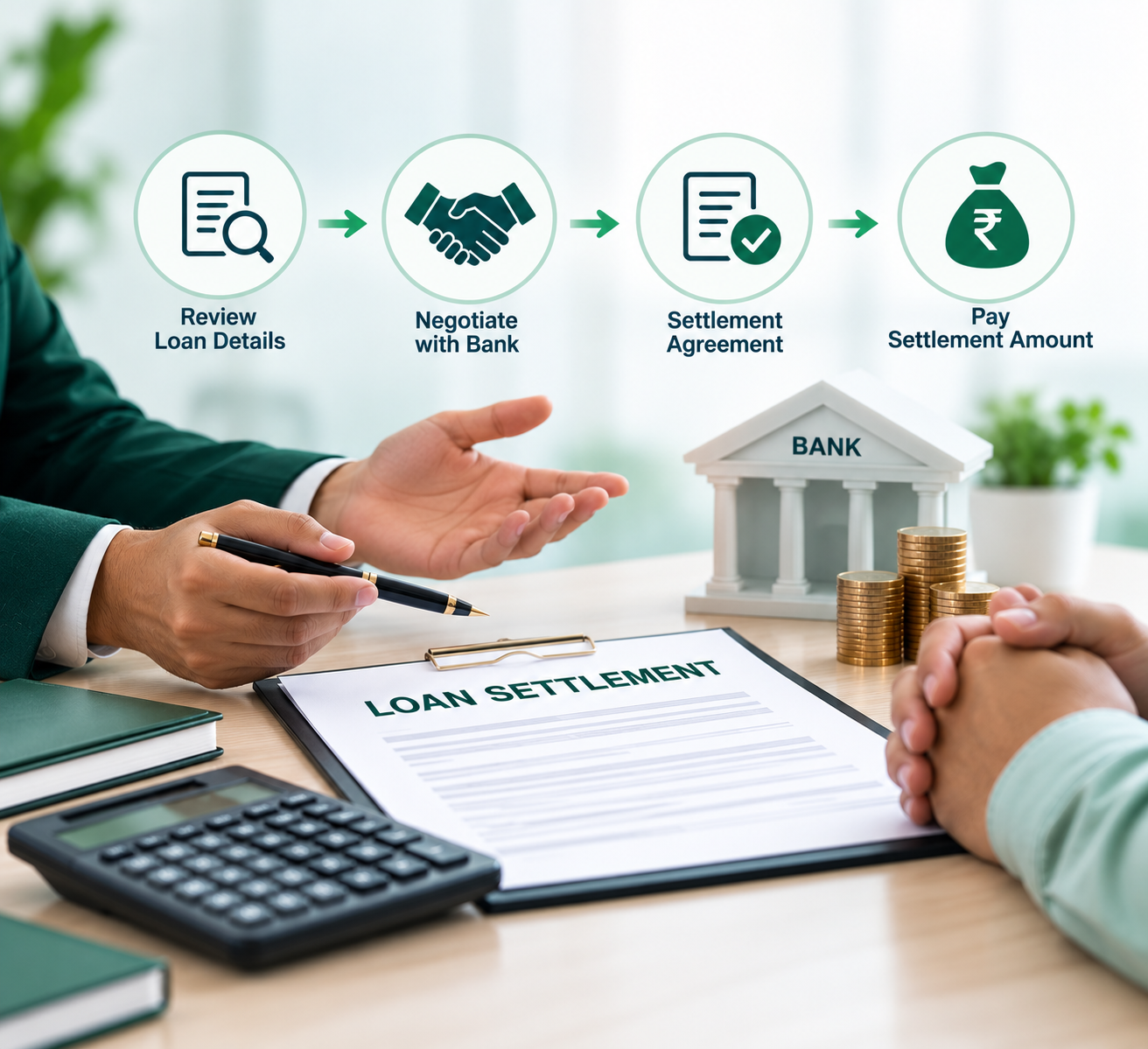
Can Loan Settlement Be Considered When Debt Becomes Unmanageable?
In some cases, a borrower facing genuine financial hardship may explore loan settlement with the lender.
A settlement is a negotiated arrangement in which the lender agrees to accept an amount to settle its claim, subject to the lender's approval and applicable policies.
It is important to understand that:
Loan settlement is not automatic.
A debt-resolution company cannot unilaterally decide what a lender will accept.
The lender ultimately has to agree to the settlement terms.
Does Loan Settlement Mean the Debt Is Simply Forgiven?
Not exactly.
Settlement generally means that the lender and borrower agree on terms under which the lender accepts a negotiated amount against the outstanding claim.
This is different from simply saying that the debt has disappeared.
Borrowers should obtain written documentation describing:
- agreed settlement amount
- payment schedule, if applicable
- payment deadline
- account details
- consequences of non-payment
- status after successful completion
Never rely solely on a verbal promise.
Will Loan Settlement Stop Recovery Calls Immediately?
Borrowers should be careful with claims such as:
“Pay us and all recovery calls will stop immediately.”
No responsible debt-resolution service should guarantee a particular outcome without reference to the lender and actual account status.
If a settlement is being discussed, obtain clarity regarding:
- who is negotiating with the lender
- whether the lender has accepted the proposal
- what amount has been agreed
- when payment must be made
- what happens after payment
- how the account will be reported
Until an arrangement is formally agreed and completed according to its terms, borro