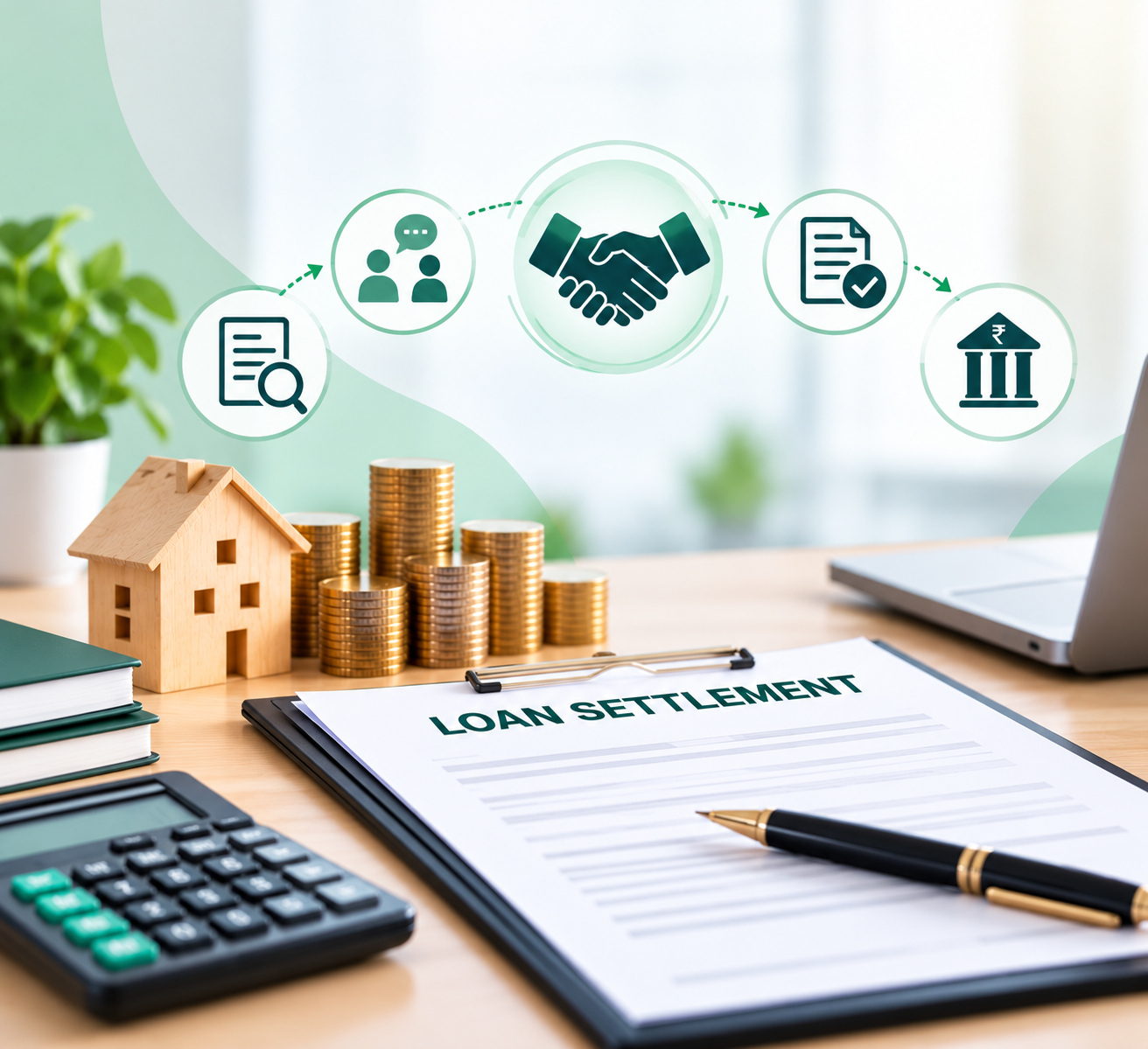

What Is Personal Loan Settlement?
Personal loan settlement is a process in which a borrower and lender agree on an amount to resolve an outstanding loan when the borrower is unable to meet the full repayment obligation.
For example, if a borrower has a significant outstanding balance and is experiencing genuine financial hardship, the lender may consider a compromise settlement under its applicable policies.
The agreed amount could be lower than the total outstanding amount. If the borrower pays the agreed settlement amount according to the approved terms, the lender may report the account as “settled” rather than “closed.”
TransUnion CIBIL defines a settled account as one where partial payment has been made with the lender's consent against the total outstanding amount.
Important:
Loan settlement is not the same as loan closure.
A closed loan generally indicates that the repayment obligation has been fully met. A settled account can indicate that the lender accepted less than the full amount originally due.
That distinction can matter when you apply for credit in the future.
Is Personal Loan Settlement Available in India?
Yes, compromise settlements are recognised within the regulatory framework applicable to regulated entities.
The Reserve Bank of India issued its Framework for Compromise Settlements and Technical Write-offs in June 2023. The framework requires regulated entities covered by it to have board-approved policies governing compromise settlements and specifies how such proposals should be approved and treated.
However, this does not mean that every borrower automatically qualifies for settlement.
The lender evaluates the account according to its policies, the borrower's circumstances, outstanding dues, repayment history, and other relevant factors.
Therefore:
A borrower can request or explore personal loan settlement, but the lender decides whether to approve it and on what terms.
Who May Consider Personal Loan Settlement?
There is no single universal eligibility formula applicable to every lender.
Settlement may be worth exploring when a borrower has a genuine and sustained difficulty in repaying the full outstanding amount.
Possible situations include:
- Loss of employment
- Significant reduction in income
- Business losses
- Major unexpected expenses
- Medical or family emergencies
- Multiple unsecured loans
- Excessive EMI burden
- Prolonged repayment difficulty
- Large overdue amounts
- Multiple credit card obligations
- A loan account that has become seriously overdue
The key consideration is repayment capacity.
If you can comfortably continue paying the loan under its existing terms, settlement may not be the most appropriate route.
Who May Not Need Loan Settlement?
Settlement should not automatically be considered simply because an EMI feels inconvenient.
If you have sufficient income and can reasonably maintain the repayment schedule, continuing regular repayment may be financially and credit-wise preferable.
You may also want to explore alternatives such as:
- Restructuring
- EMI management
- Tenure modification
- Debt consolidation
- Repayment planning
- Direct discussion with the lender
The right option depends on your complete financial situation.
Personal Loan Settlement Eligibility: What Do Lenders Consider?
Although each lender has its own policies, several factors can influence how a settlement request is assessed.
1. Current financial hardship
The lender may consider whether there is a genuine reason for the repayment difficulty.
2. Outstanding amount
The size and age of the outstanding obligation may form part of the lender's assessment.
3. Repayment history
Previous payments, missed EMIs, overdue periods, and account behaviour may be relevant.
4. Current account status
The lender may assess whether the account is regular, overdue, or otherwise classified under its applicable framework.
5. Repayment capacity
Your present ability to repay the full outstanding amount can be important.
6. Available funds
If settlement is being considered, the lender may want to understand how the agreed amount can be paid.
7. Internal lender policy
Ultimately, settlement decisions are governed by the lender's applicable policies and approval process.
There is no universal “X EMI missed = eligible for settlement” rule.
How Does Personal Loan Settlement Work?
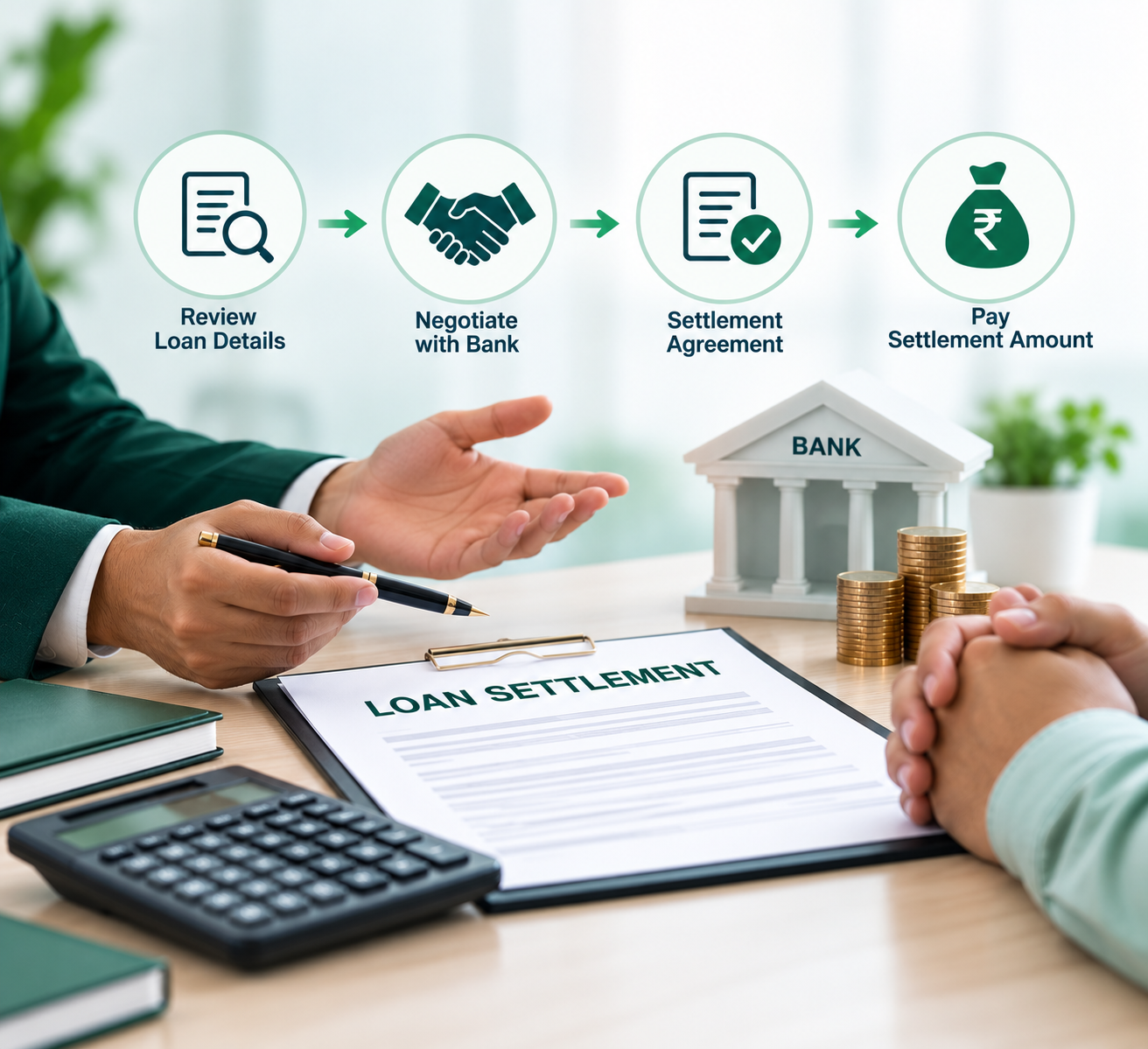
A typical settlement journey can look like this:
Step 1: Assess your total debt
List every outstanding loan and credit card.
Record:
- Outstanding principal
- Overdue amount
- EMI
- Interest
- Charges
- Loan tenure
- Number of missed payments
- Current account status
This prevents you from looking at one loan in isolation when the actual problem is multiple debts.
Step 2: Review your income and expenses
Calculate your realistic monthly position.
For example:
Monthly income – essential household expenses – existing unavoidable obligations = available repayment capacity
Do not calculate affordability using income alone.
Your essential expenses should be considered before deciding how much money can realistically be committed toward debt.
Step 3: Review your credit report
Check your credit report before making a settlement decision.
Look for:
- Personal loans
- Credit cards
- Payment history
- Overdue amounts
- Current balances
- Account status
- Recent enquiries
CIBIL notes that missed payments, overdue amounts and settled accounts can be viewed negatively by lenders when assessing future credit applications.
Step 4: Explore alternatives
Before settlement, determine whether another solution is realistic.
For example:
Can I continue repayment?
If yes, settlement may not be necessary.
Can I afford a revised repayment arrangement?
If yes, restructuring may deserve consideration.
Do I have several debts that could be evaluated together?
If yes, debt-management or consolidation options may be relevant.
Can I not realistically repay the full amount?
If so, settlement may be worth exploring.
Step 5: Discuss the situation with the lender
Explain the financial circumstances clearly.
Avoid exaggerated claims or promises you cannot fulfil.
If you are seeking settlement, ask the lender whether a settlement proposal can be considered and what documentation is required.
Step 6: Submit supporting information
Depending on the lender and circumstances, you may be asked for information relating to your income, expenses, financial hardship, existing obligations, or available funds.
Keep copies of everything submitted.
Step 7: Negotiate or review the proposed terms
If the lender considers a settlement, carefully review:
- Settlement amount
- Payment deadline
- Instalment terms, if any
- Applicable conditions
- Treatment of remaining dues
- Account status after settlement
- Documents to be issued after payment
Do not judge a settlement only by the percentage reduction.
A lower settlement amount is not automatically a better financial decision if the arrangement creates other problems.
Step 8: Obtain written approval
Before making a significant payment, obtain the settlement terms in writing.
A verbal assurance from a caller or intermediary should not be treated as sufficient evidence of an approved settlement.
Step 9: Make payment through a verified channel
Pay only through an authorised channel specified by the lender or as documented in the approved settlement arrangement.
Keep:
- Payment receipts
- Bank transaction records
- Emails
- Letters
- Settlement documents
- Account statements
Step 10: Obtain post-settlement documentation
After completing the settlement terms, request appropriate written confirmation from the lender.
Depending on the case, this may include a settlement letter, account statement, or other relevant documentation.
How Much Does Personal Loan Settlement Cost?
There is no standard personal loan settlement cost or fixed settlement percentage in India.
The amount depends on the specific lender, account, outstanding balance, financial circumstances, repayment history, and approved settlement terms.
You may see advertisements claiming:
- “Settle your loan for 20%”
- “Get 80% waiver”
- “Guaranteed 90% settlement”
- “Pay only a small percentage of your loan”
These should not be treated as universal rules.
The important question is not:
“What percentage can I get?”
Instead ask:
“What settlement amount can the lender actually approve for my specific account, and what are the consequences?”
The RBI framework requires regulated entities to maintain board-approved policies for compromise settlements and establish appropriate approval processes.
Are There Additional Charges for Loan Settlement?
Potential costs depend on the service provider and arrangement.
Before engaging any third party, ask for a complete written breakdown of:
- Professional/service fees
- Taxes, if applicable
- Documentation charges
- Other applicable costs
- Payment schedule
- Refund policy, if applicable
Do not assume that a “settlement amount” advertised online includes every possible cost.
Also verify exactly who receives each payment.
Does Personal Loan Settlement Affect CIBIL Score?
Yes, personal loan settlement can affect your credit profile.
When a lender accepts an amount lower than the total amount originally payable, the account may be reported as “Settled.”
CIBIL explains that “settled” and “closed” are different account statuses and that settled accounts are not viewed favourably by lenders.
CIBIL's educational material also gives an example where a personal loan settled for less than the full amount was reported as “settled,” and the borrower subsequently faced difficulty obtaining another loan.
This means:
Loan settlement can help resolve a difficult debt situation, but it can also have consequences for future borrowing.
Therefore, settlement should not be marketed as a way to improve CIBIL immediately.
Settlement vs Closed: What Is the Difference?
This is one of the most important distinctions borrowers should understand.
|
Status |
General meaning |
|
Closed |
Loan obligation has been fully repaid according to the lender's records |
|
Settled |
Lender has accepted an agreed amount lower than the total outstanding |
|
Written off |
Lender has written off the amount for accounting/reporting purposes; this does not necessarily mean the borrower has no obligation |
CIBIL's consumer information specifically distinguishes settled and written-off statuses from a clean closed account.
Can a “Settled” Status Be Changed to “Closed”?
Potentially, depending on the circumstances and the lender's confirmation.
CIBIL explains a scenario where the borrower subsequently paid the remaining amount, obtained an NOC from the bank, raised a dispute, and the lender confirmed the updated status. The account was then changed from “settled” to “closed.”
The important point is that CIBIL does not independently decide to rewrite a lender's account information.
If the information is inaccurate, the correction process involves the relevant lender/credit institution.
How Long Does Personal Loan Settlement Affect Your Credit?
There is no simple universal answer such as “settlement damages your CIBIL for exactly X years.”
Your credit profile reflects a broader history of borrowing and repayment.
Future lenders may consider:
- Payment behaviour
- Account status
- Current outstanding debt
- Recent repayment history
- Existing credit exposure
- Credit enquiries
- Overall financial profile
CIBIL notes that past credit behaviour can have a long-lasting effect on future credit decisions.
Therefore, after resolving debt, consistent responsible credit behaviour becomes important.
Can Loan Settlement Reduce Your CIBIL Score?
The exact numerical change cannot be guaranteed.
A credit score is calculated using multiple elements of your credit history, so it would be misleading to promise that settlement will reduce or increase the score by a particular number.
What can be said more reliably is that a settled account can be viewed negatively by lenders, particularly when compared with a fully closed account.
Personal Loan Settlement vs Restructuring
Borrowers often confuse settlement and restructuring.
Personal Loan Settlement
The lender agrees to accept an amount to resolve the account that may be lower than the total amount due.
Loan Restructuring
The lender changes repayment terms to make the obligation more manageable.
CIBIL's consumer material describes restructuring as a lender offering different terms, such as extending the loan tenure or reducing the interest rate.
Which is better?
There is no universal answer.
If you can repay the loan under revised terms, restructuring may be worth exploring.
If you genuinely cannot repay the full obligation, settlement may be an option to discuss.
Personal Loan Settlement vs Debt Consolidation
These are also different strategies.
Settlement attempts to resolve an existing debt through an agreed amount.
Debt consolidation generally combines multiple debts into a single repayment structure, usually subject to eligibility and affordability.
Consolidation is not automatically better because it may involve taking new credit.
Before choosing it, consider:
- Interest rate
- New EMI
- Loan tenure
- Processing fees
- Total repayment
- Your ability to maintain the new payment
What Happens If You Stop Paying Your Personal Loan?
Stopping EMI payments can have consequences.
Depending on the lender and account status, you may face:
- Overdue amounts
- Applicable charges
- Recovery communication
- Negative credit reporting
- Escalation of the account
- Potential legal or other recovery action depending on the circumstances
Therefore, deliberately stopping payments just to force a settlement is not a strategy that should be treated as risk-free.
If you are already unable to pay, communicate with the lender and understand your available options.
What If Recovery Agents Are Calling Me?
Borrowers facing repayment difficulties may receive collection calls or other recovery communication.
Regulated entities and their recovery agents are subject to RBI requirements concerning recovery conduct.
For example, RBI has directed regulated entities to ensure that they and their recovery agents do not resort to intimidation or harassment. The instructions also address inappropriate messages, threatening or anonymous calls, persistent calling, and calling borrowers before 8 a.m. or after 7 p.m. for recovery of overdue loans.
If you are facing problematic recovery behaviour:
- Keep records of communications.
- Ask for the identity of the caller and the lender they represent.
- Communicate through appropriate official channels.
- Use the lender's grievance mechanism where necessary.
- Seek appropriate professional or legal guidance where the situation requires it.
Do not assume that every recovery communication is unlawful simply because you are receiving calls. The circumstances and conduct matter.
Is Personal Loan Settlement the Same as Loan Forgiveness?
No.
Settlement does not mean that a lender has simply forgiven your entire debt.
It means the lender has agreed to resolve the account under specific terms.
The settlement amount, conditions, payment timeline, and account treatment should be documented.
Can a Debt Settlement Company Guarantee a Settlement?
No company can guarantee that a particular lender will approve a specific settlement amount.
A debt-resolution company may assist with assessment, documentation, communication, or negotiation depending on its service model.
But the final decision belongs to the lender.
Be particularly cautious about claims such as:
- Guaranteed loan settlement
- Guaranteed 80% reduction
- Guaranteed CIBIL improvement
- Guaranteed removal of default
- Guaranteed loan approval after settlement
- Guaranteed stopping of all recovery activity
A trustworthy process should explain both the potential benefits and the risks.
What Should You Check Before Choosing a Loan Settlement Company?
If you are considering professional assistance, ask:
1. Is the fee clearly explained?
Ask for a written fee structure.
2. Who will communicate with the lender?
Understand whether communication is direct, assisted, or handled through an authorised representative.
3. Will you receive written documentation?
Do not rely entirely on phone calls or WhatsApp messages.
4. Where should payments be made?
Verify that payment instructions are legitimate.
5. Are settlement outcomes guaranteed?
They should not be presented as guaranteed.
6. Are the CIBIL consequences explained?
A responsible provider should explain that “settled” can be viewed negatively by lenders.
7. Are alternatives discussed?
Settlement should not be presented as the only possible option.
Documents You Should Keep for Personal Loan Settlement
Create a dedicated folder containing:
- Loan agreement
- Loan account statement
- EMI payment records
FAQ
Frequently Asked Questions
Find clear answers to the most common questions about debt settlement.
Personal loan settlement is an arrangement where a lender agrees to accept a specified amount to resolve an outstanding personal loan, potentially lower than the total amount originally due.There is no universal eligibility rule. Lenders may consider financial hardship, account status, repayment history, outstanding dues, repayment capacity, and their own settlement policies.There is no fixed settlement percentage. The amount depends on the lender, loan account, financial circumstances, outstanding balance, and approved settlement terms.Yes. A settled account can be viewed less favourably by lenders than a closed account. CIBIL specifically distinguishes the two statuses.Not necessarily. If you can repay under revised terms, restructuring may be worth exploring. Settlement may be considered where full repayment is not realistically affordable.Settlement availability depends on the lender's policies and the circumstances of the account. Borrowers should not deliberately delay repayment simply to pursue settlement.Each loan may need to be assessed separately because different lenders can have different policies and approval processes. However, your overall debt position should be evaluated together.Yes. A lender is not required to accept every settlement proposal. Settlement is subject to the lender's applicable policy and approval process.Settlement does not mean the credit history automatically disappears. The lender reports the account status to the credit bureau, and the account can continue to appear in the credit report.It may be possible in certain circumstances if the remaining amount is subsequently paid and the lender confirms the change. CIBIL describes such a process in its consumer education material.No fixed discount can be guaranteed across lenders. The final settlement amount is determined through the lender's approval process.No. Stopping payments solely to force settlement can create additional financial and credit consequences. Understand your options before changing your repayment behaviour.Review your finances, contact the lender, understand repayment or restructuring options, and assess whether settlement is appropriate. If you have several debts or complex recovery issues, professional debt-resolution guidance may also be considered.