What Is Personal Loan Settlement?
Personal loan settlement is an arrangement in which a lender agrees to accept a specified amount to resolve an outstanding loan, which may be less than the total amount originally due.
The important point is that settlement requires the lender's agreement. A borrower cannot unilaterally decide to pay a smaller amount and consider the loan settled.
For example, suppose a borrower has an outstanding personal loan balance of ₹5 lakh but is facing genuine financial hardship and cannot repay the full amount. The borrower may approach the lender or an authorised debt-resolution professional to understand whether a settlement discussion is possible.
If the lender agrees to a settlement amount of ₹3 lakh, and the borrower fulfils the agreed payment terms, the account may be reported as “settled” rather than “closed.”
The exact outcome depends on the lender, account status, settlement terms, and applicable policies.
TransUnion CIBIL explains that a “settled” account generally means the borrower and lender agreed to a payment lower than the amount originally outstanding.
Is Personal Loan Settlement Legal in India?
Loan settlement is not inherently illegal. Regulated lenders can have policies for compromise settlements, subject to applicable regulatory requirements and their internal processes.
However, borrowers should distinguish between:
- A settlement approved by the lender
- A repayment arrangement
- Loan restructuring
- Loan closure
- A write-off
- An informal promise made by an individual or third party
The lender ultimately decides whether it will accept a settlement proposal.
Therefore, no company or intermediary should guarantee that a particular lender will definitely settle your loan for a specific percentage.
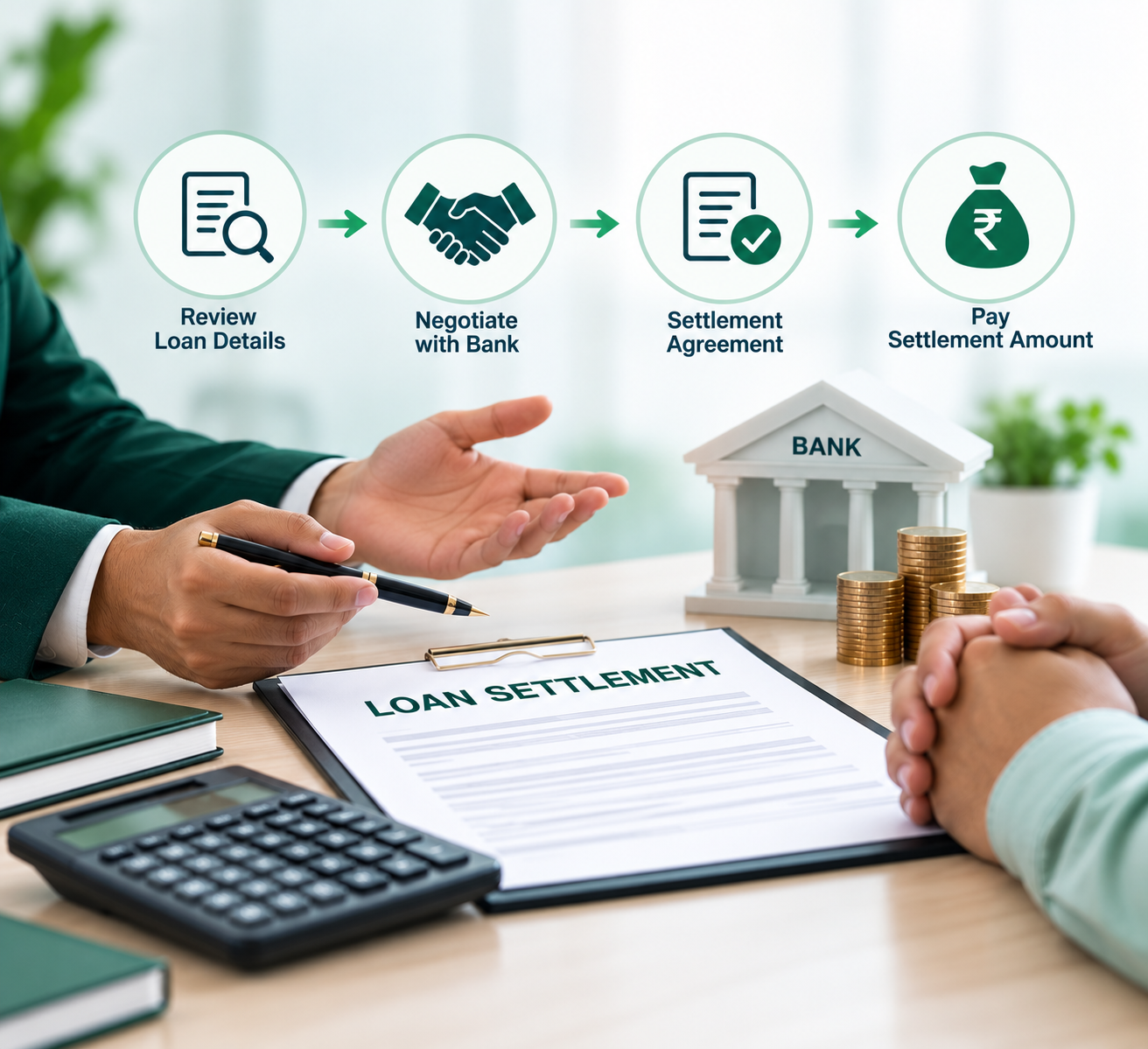
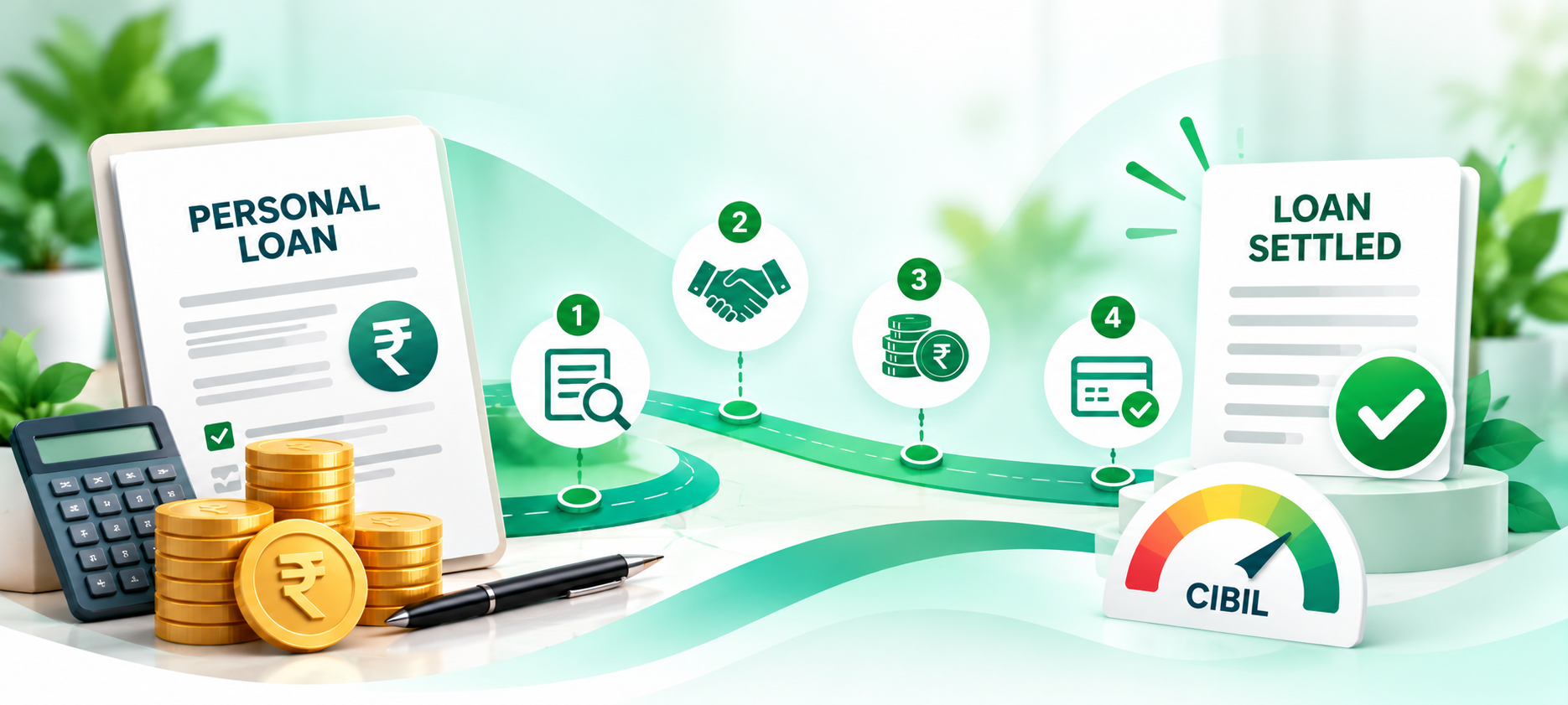
How to Settle a Personal Loan in India: Step-by-Step Process
The following process can help you approach a personal loan settlement in a more structured way.
Step 1: Understand Your Current Loan Position
Before discussing settlement, collect accurate information about your loan.
Check:
- Original loan amount
- Current outstanding balance
- Number of EMIs paid
- Number of missed or overdue EMIs
- Current overdue amount
- Interest and applicable charges
- Loan tenure
- Current account status
- Lender or financial institution
- Any recovery communication received
- Any legal notice received
Do not rely only on phone calls or verbal statements.
Ask the lender for an updated statement or account information wherever appropriate.
Step 2: Check Your Credit Report
Before making a decision, review your CIBIL report and other available credit information.
Your credit report can help you understand:
- Existing loans
- Credit card accounts
- Payment history
- Amounts overdue
- Account status
- Outstanding balances
- Recent credit enquiries
CIBIL states that payment history and account information are important parts of a credit report and are considered by lenders when assessing credit applications.
This is especially important if you have multiple loans or credit cards, because settling one account may not solve the broader debt problem.
Step 3: Assess Whether Settlement Is Actually Necessary
Do not assume that settlement is automatically the best option.
Depending on your financial position, you may have several possible routes:
Option 1: Continue Normal Repayment
If you can realistically afford the EMI, continuing regular repayment is generally preferable to allowing the account to deteriorate.
Option 2: Request Restructuring
Depending on the lender and your circumstances, you may ask whether restructuring or another repayment arrangement is available.
This could potentially involve changes to repayment terms, tenure, or other conditions subject to lender approval.
Option 3: Debt Consolidation
If you have several debts and qualify for suitable credit, consolidation may be worth evaluating. However, taking another loan is not automatically a solution and should only be considered after reviewing affordability.
Option 4: Negotiate a Settlement
If you genuinely cannot repay the full outstanding amount and other realistic options are not workable, settlement may be considered.
Option 5: Seek Professional Guidance
If your debt situation involves multiple lenders, overdue accounts, recovery pressure, or complicated documentation, professional debt-resolution guidance may help you understand the available options.
Step 4: Prepare Evidence of Financial Hardship
A lender may consider your overall circumstances when evaluating a repayment or settlement request.
Depending on your situation, useful documents may include:
- Salary slips
- Bank statements
- Employment-related documents
- Income proof
- Business financial records
- Medical or emergency expense documentation, where relevant
- Existing loan statements
- Credit card statements
- Proof of significant financial obligations
- Previous communication with the lender
The exact documentation required varies by lender.
The purpose is to present a clear and credible picture of your repayment capacity.
Step 5: Contact the Lender or Authorised Representative
The next step is to communicate with the lender through an appropriate channel.
Explain your situation clearly.
For example:
“I am currently facing financial difficulty and am unable to maintain the existing repayment schedule. I would like to understand the available options for resolving my outstanding loan account.”
Avoid making unrealistic promises about payments you cannot afford.
If you are considering settlement, ask whether the lender is willing to review a settlement proposal.
Step 6: Determine an Affordable Settlement Amount
One of the biggest mistakes borrowers make is agreeing to an amount they cannot actually pay.
Before making a proposal, calculate:
Available funds = savings + realistic monthly surplus + other legally available resources
Do not use essential household funds simply to make a settlement payment without considering your ability to meet basic expenses.
If a settlement is accepted, the payment schedule and amount should be clearly documented.
Step 7: Review the Settlement Offer Carefully
If the lender agrees to a settlement, do not rely solely on a verbal conversation.
Obtain written documentation containing the important terms.
Check:
- Borrower's name
- Loan/account number
- Total outstanding amount
- Agreed settlement amount
- Payment deadline
- Instalment schedule, if applicable
- Applicable conditions
- Consequences of missing the settlement payment
- Treatment of remaining dues
- Account closure/settlement status
- Documents that will be issued after payment
Read the document carefully before making payment.
Step 8: Make Payment Through an Official Channel
This is extremely important.
Never transfer a settlement amount to a personal bank account, personal UPI ID, QR code, or an unverified payment channel simply because someone claims to represent a lender or debt-resolution company.
Verify the payment instructions through the appropriate official channel.
Keep:
- Payment receipt
- Bank transaction details
- Settlement letter
- Email correspondence
- WhatsApp/SMS communication
- Account statement
- NOC or relevant closure/settlement documentation
These documents may become important later.
Step 9: Obtain Written Confirmation After Payment
Once the agreed settlement amount has been paid, ask for written confirmation from the lender.
Depending on the agreement, this may include:
- Settlement confirmation
- No-dues documentation
- Account statement
- Relevant closure/settlement letter
- Updated account status
Do not assume that making a payment automatically means every record has been updated.
Step 10: Check Your CIBIL Report After Settlement
This is one of the most important steps.
A loan that has been settled for less than the full amount may be reported as “Settled” rather than “Closed.”
CIBIL specifically notes that lenders may view a settled status less favourably than a closed account.
Therefore, borrowers should understand the potential credit consequences before choosing settlement.
After the lender has processed the settlement, monitor your credit report to ensure that the account information reflects the lender's reported status accurately.
CIBIL also explains that it cannot independently change lender-reported information; corrections generally require confirmation from the relevant credit institution.
What Happens to Your CIBIL Score After Personal Loan Settlement?
This is one of the most common questions borrowers ask.
Does loan settlement affect CIBIL?
Yes, a settlement can negatively affect how your credit profile is viewed.
When a lender accepts less than the full amount due, the account may be reported as “Settled.” CIBIL explains that lenders can view such a status negatively because it indicates that the original repayment obligation was not fully met.
However, the impact on an individual's credit profile is not simply determined by one number.
Lenders may consider:
- Payment history
- Outstanding debt
- Account status
- Credit utilisation
- Recent enquiries
- Existing loans
- Overall credit behaviour
Therefore, loan settlement should not be presented as a guaranteed way to improve your CIBIL score.
Can “Settled” Be Changed to “Closed”?
A “settled” account cannot simply be changed by asking CIBIL to delete it.
CIBIL states that it does not independently modify lender-provided information. Updates generally depend on information supplied or confirmed by the relevant lender.
In some circumstances, if the borrower subsequently pays the remaining amount and the lender confirms the change, the reported status may be updated.
CIBIL provides an example where additional payment and lender confirmation resulted in a “settled” status being changed to “closed.”
The important lesson is:
Do not choose settlement assuming that the CIBIL status will automatically become “closed.”
When Should You Consider Personal Loan Settlement?
Settlement may be worth exploring when a borrower has a genuine and sustained inability to repay the full debt and normal repayment or restructuring options are not realistically affordable.
Situations may include:
- Significant reduction in income
- Job loss
- Business losses
- Multiple unsecured loans
- Large accumulated overdue amounts
- Serious financial emergencies
- Excessive EMI burden
- Multiple credit card obligations
- Prolonged repayment difficulty
However, every case is different.
A borrower who can comfortably continue repayment may have little reason to choose settlement.
When Should You Avoid Loan Settlement?
Settlement may not be appropriate if you can reasonably afford to repay the loan under the existing terms.
You should also be cautious if someone is encouraging you to:
- Stop paying immediately
- Hide information from the lender
- Transfer money to an individual's account
- Sign documents without reading them
- Take another expensive loan just to fund settlement
- Believe that settlement will automatically improve your CIBIL score
- Expect a guaranteed percentage reduction
A legitimate debt-resolution process should explain both benefits and potential consequences.
Personal Loan Settlement vs Restructuring
These two options are often confused.
|
Personal Loan Settlement |
Loan Restructuring |
|
May involve accepting less than the total outstanding amount |
Usually changes repayment terms |
|
Requires lender approval |
Requires lender approval |
|
May result in “Settled” reporting |
May have different reporting depending on lender/account |
|
Can affect future credit access |
Impact depends on the arrangement and repayment behaviour |
|
Generally considered when full repayment is difficult |
May be considered when repayment is possible under revised terms |
The better option depends on your financial circumstances.
If you can afford repayment under revised terms, restructuring may deserve consideration before settlement.
Personal Loan Settlement vs Loan Closure
Loan closure generally means the borrower has fulfilled the repayment obligation according to the agreed terms.
Settlement generally involves an agreed payment that is lower than the full amount originally due.
This distinction matters because CIBIL explains that “settled” and “closed” are different account statuses and can be viewed differently by lenders.
What Happens If You Cannot Pay Your Personal Loan EMI?
If you miss an EMI, the consequences can depend on the lender, loan agreement, duration of the overdue, and your subsequent repayment.
Possible consequences may include:
- Amount becoming overdue
- Additional applicable charges
- Negative payment-history information
- Recovery communication
- Increased financial pressure
- Potential impact on future credit applications
- Escalation of the account if the overdue continues
If the account remains unpaid for an extended period, its classification can become more serious under applicable regulatory and lender frameworks.
Therefore, do not wait until the situation becomes unmanageable before understanding your options.
What Is NPA in a Personal Loan?
NPA stands for Non-Performing Asset.
For applicable term loans, regulatory frameworks generally use an overdue period of more than 90 days as an important threshold for NPA classification, subject to the applicable rules and lender category.
NPA status does not mean the loan has disappeared or been cancelled.
A borrower may still need to resolve the outstanding obligation through repayment, restructuring, settlement, or another lender-approved arrangement, depending on the circumstances.
If your account is approaching or has reached a serious overdue stage, getting accurate information early can help you understand the options available.
Can a Personal Loan Be Settled Before NPA?
A borrower should not assume that settlement is available only after an account becomes an NPA.
The availability and terms of any settlement depend on the lender's policies and the specific account.
If you are experiencing financial difficulty, it may be better to contact the lender early and understand whether repayment assistance, restructuring, or another option is available rather than deliberately allowing the account to deteriorate.
What Documents Are Useful for Loan Settlement?
A borrower may want to keep the following documents ready:
Personal information
- PAN
- Address proof
- Identity documents
- Loan account details
Financial information
- Bank statements
- Salary slips
- Income documents
- Existing loan statements
- Credit card statements
Financial hardship evidence
Where applicable:
- Employment-related documents
- Business loss information
- Medical expense documentation
- Other relevant evidence of financial difficulty
The exact documents required depend on the lender and circumstances.
How Much Can a Personal Loan Be Settled For?
There is no universal settlement percentage that applies to every personal loan in India.
You may see companies or online advertisements claiming that loans can always be settled for a specific percentage of the outstanding amount. Such claims should be treated cautiously.
The final amount depends on factors such as:
- Lender policy
- Outstanding amount
- Account status
- Borrower's financial circumstances
- Repayment history
- Available funds
- Negotiation
- Internal approval
- Terms offered by the lender
There is no guaranteed settlement percentage.
A responsible debt-resolution process should set realistic expectations rather than promise a fixed discount.
Is Loan Settlement the Same as Loan Forgiveness?
No.
Loan settlement is an agreement between the borrower and lender regarding payment of an outstanding obligation.
It does not mean that the borrower automatically receives complete forgiveness of the debt.
The exact terms must be established in writing by the lender.
Can a Debt Settlement Company Guarantee Loan Settlement?
A company can provide guidance, negotiation support, or debt-resolution assistance depending on its services, but the lender makes the final decision on whether to accept a settlement.
Therefore, be cautious about anyone promising:
- Guaranteed settlement
- Guaranteed 80%–90% waiver
- Guaranteed CIBIL improvement
- Guaranteed loan approval after settlement
- Guaranteed removal of default
- Guaranteed deletion of credit history
A borrower's outcome depends on the specific lender, account, financial circumstances, and applicable terms.
How Can ReducedDebts Help?
ReducedDebts is a debt resolution platform in India that helps individuals understand and explore options related to loans, credit cards, EMIs, and other debt-related financial challenges.
Depending on the situation, borrowers may seek guidance related to:
- Personal loan settlement
- Loan settlement